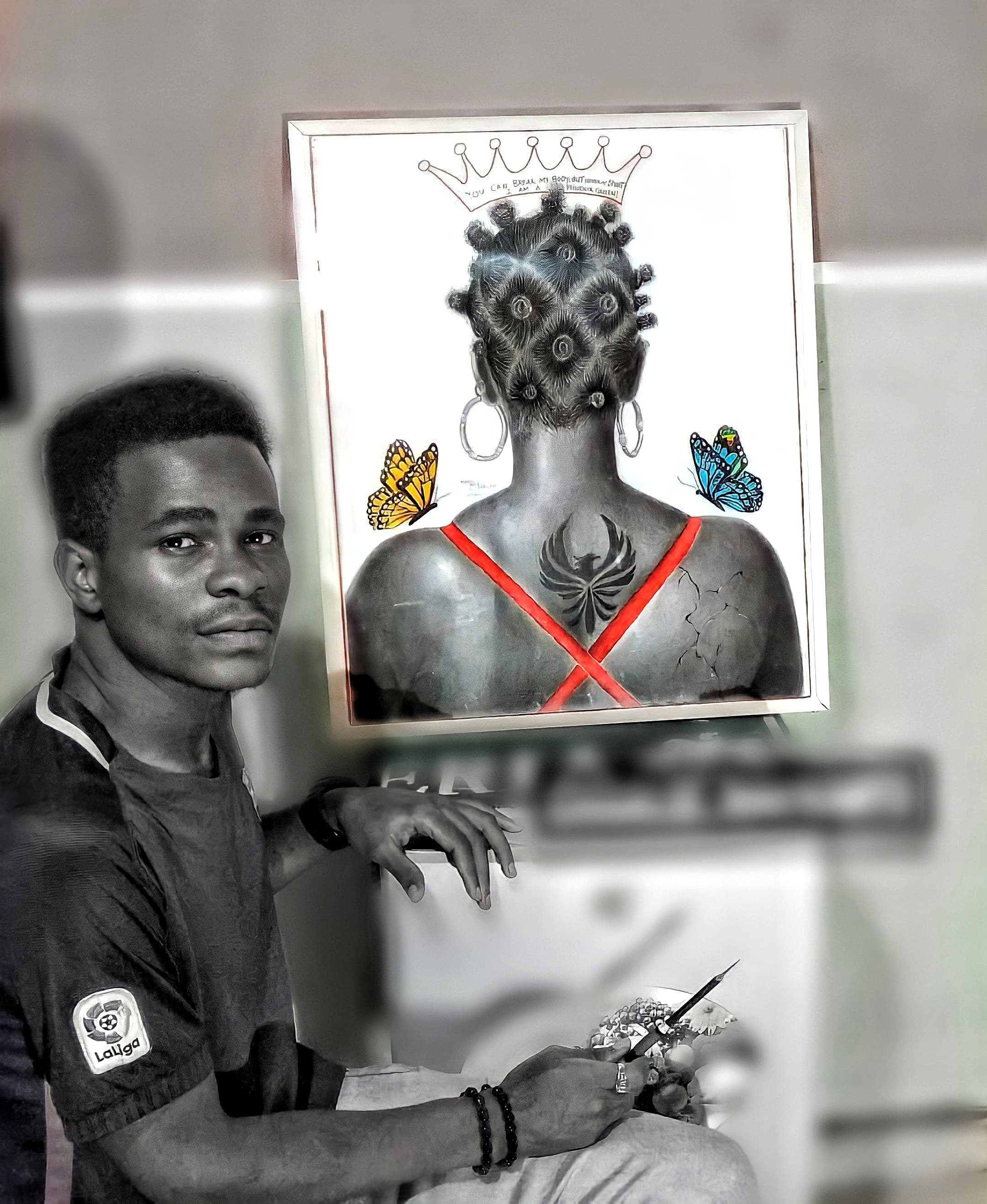
Charlse Mbeh
Artist
Artist statement
I create conceptual Charcoal and Acrylic Portraits that turn familiar faces, everyday objects, and cultural symbols into questions about the world we live in. While exploring other mediums too like Ballpoint Pen and Pastels to tell Creative stories.
My portraits are not simply representations of individuals; they are constructed narratives in which the subject becomes a vessel for larger questions.
My work explores the tensions between memory, power, love, loss, culture, and social injustice. I am interested in the stories that exist beneath the surface of a portrait—the things we inherit, the things we survive, and the things we are afraid to say out loud.
Transforming everyday objects into symbolic language, objects associated with domestic life and survival are removed from their ordinary functions and reimagined in my portraits. By so doing, the familiar becomes unsettling. An object associated with nourishment may instead reveal what a society has been fed—ideologically, culturally, or emotionally.
I often use ordinary objects in unexpected ways, transforming them into visual metaphors. A spoon can become a symbol of power. A plate can become a stage for silence. A familiar gesture can carry the weight of an entire history. Through these transformations, I invite the viewer to look beyond the image and question the meaning behind it.
My practice is also deeply rooted in the human experience, particularly the contradictions that shape our contemporary lives: beauty and pain, privilege and suffering, love and loss, silence and resistance. I am drawn to stories that are personal but carry something universal—stories that can begin with one individual and ultimately speak to an entire society.
Portraiture, for me, is therefore more than the representation of a person. It is a language. It allows me to preserve memory, confront uncomfortable realities, and create conversations that may otherwise never happen.
I am particularly drawn to moments when silence becomes complicity, when memory becomes resistance, and when an individual experience reflects a much larger social reality.
I want my work to be beautiful enough to draw you closer, but honest enough to make you uncomfortable once you arrive.
Because sometimes, the most important thing a portrait can do is not tell you who someone is—but make you question what you thought you already knew.